
First Impressions
By James Hann, AIA
Oasis: The Luxury Collection
2007 Edition
pp. 16-17
Creating a Hierarchy of Spaces
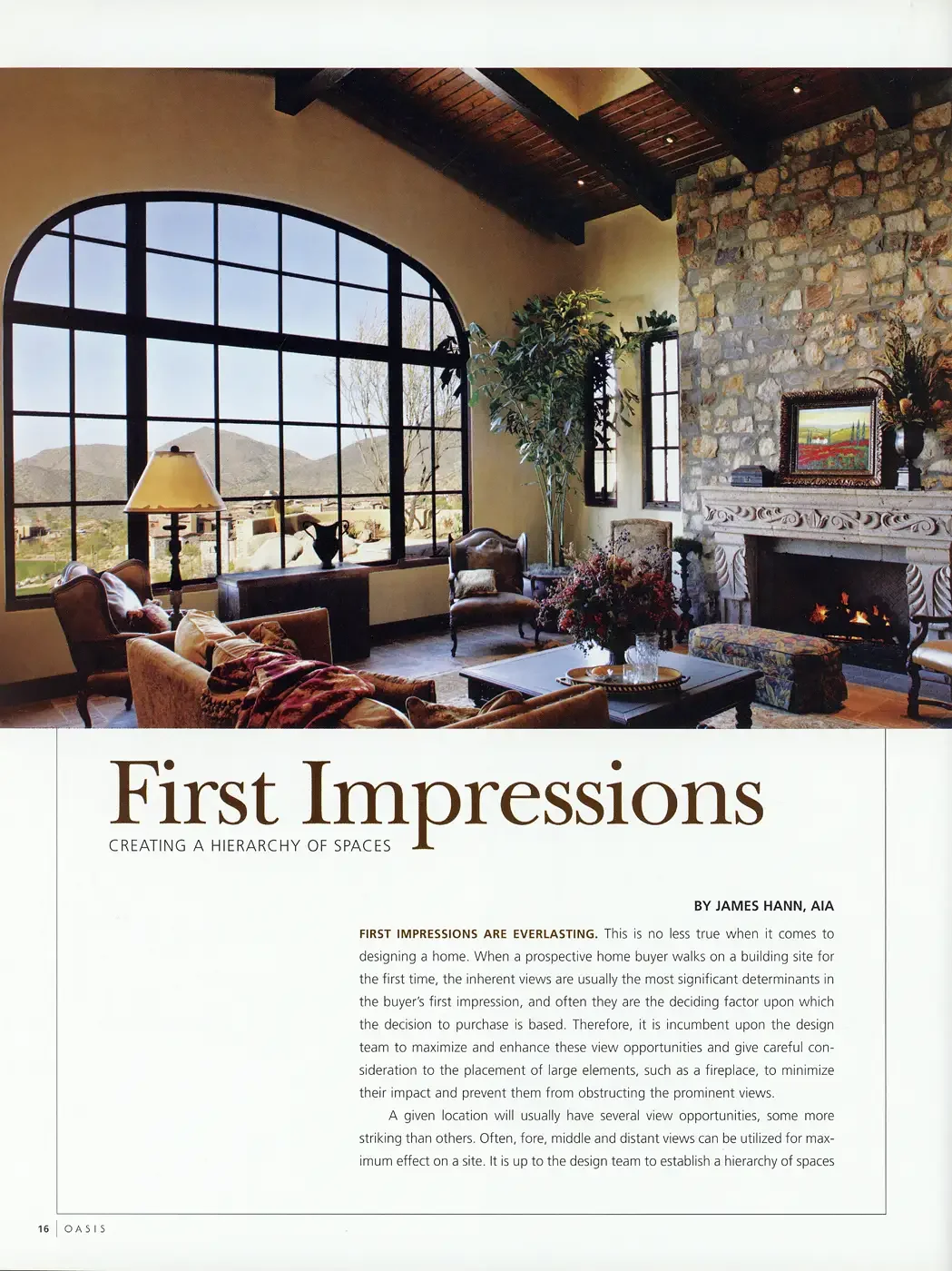
FIRST IMPRESSIONS ARE EVERLASTING. This is no less true when it comes to designing a home. When a prospective home buyer walks on a building site for the first time, the inherent views are usually the most significant determinants in the buyer’s first impression, and often they are the deciding factor upon which the decision to purchase is based. Therefore, it is incumbent upon the design team to maximize and enhance these view opportunities and give careful consideration to the placement of large elements, such as a fireplace, to minimize their impact and prevent them from obstructing the prominent views.
A given location will usually have several view opportunities, some more striking than others. Often, fore, middle and distant views can be utilized for maximum effect on a site. It is up to the design team to establish a hierarchy of spaces that best promotes each view in accordance with its associated use. Throughout the course of the day, the views often take on a different character. With thoughtful design, these variations can harmonize with the natural rhythms of our daily routines.
The first opportunity occurs at the entry, which should be obvious but is often a visual screen to what lies beyond. The surprise and grandeur that are created when one actually enters the home should be striking and are usually one of the most important considerations when designing a home. This view should invite the prospective buyer into the space and encourage further exploration. It should entice the viewer to wonder what lies ahead or just around the next corner.
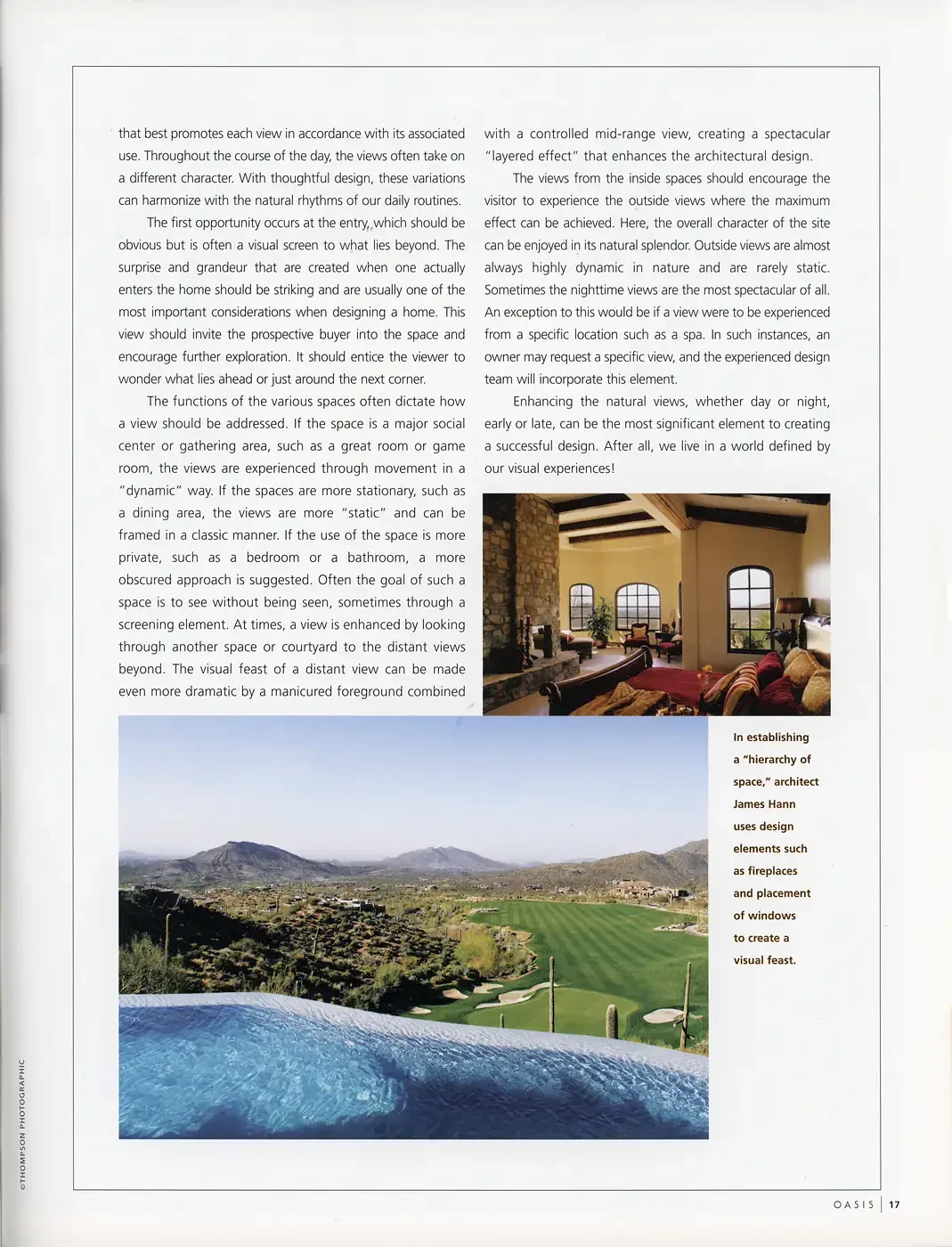
The functions of the various spaces often dictate how a view should be addressed. If the space is a major social center or gathering area, such as a great room or game room, the views are experienced through movement in a “dynamic” way. If the spaces are more stationary, such as a dining area, the views are more “static” and can be framed in a classic manner. If the use of the space is more private, such as a bedroom or a bathroom, a more obscured approach is suggested. Often the goal of such a space is to see without being seen, sometimes through a screening element. At times, a view is enhanced by looking through another space or courtyard to the distant views beyond. The visual feast of a distant view can be made even more dramatic by a manicured foreground combined with a controlled mid-range view, creating a spectacular “layered effect” that enhances the architectural design.
The views from the inside spaces should encourage the visitor to experience the outside views where the maximum effect can be achieved. Here, the overall character of the site can be enjoyed in its natural splendor. Outside views are almost always highly dynamic in nature and are rarely static. Sometimes the nighttime views are the most spectacular of all. An exception to this would be if a view were to be experienced from a specific location such as a spa. In such instances, an owner may request a specific view, and the experienced design team will incorporate this element.
Enhancing the natural views, whether day or night, early or late, can be the most significant element to creating a successful design. After all, we live in a world defined by our visual experiences!